
Success Story
Ruedi Aebersold Interview “We Now Have an Amazing Opportunity to Shape the Next Phase of Personalized Health”
Interview
Excellent data has been collected in recent years, but now, a new framework program is needed to build on this success, says Ruedi Aebersold, the driving force behind PHRT

SystemsX.ch, the predecessor program to PHRT, received 220 million Swiss francs from the federal government, and PHRT received 100 million Swiss francs. Now, after eight years, PHRT is coming to an end and will not be continued. Has the project failed?
Ruedi Aebersold: I don’t think that PHRT has failed, it has a strong track record in terms of its accomplishments. But it is disappointing to me that it will not continue. These types of programs always run in four-year phases, defined by the federal budget cycle. After the start of the second phase in August 2022, PHRT and SPHN organized the 2nd Joint Personalized Health Day in Bern, where a representative of the State Secretary for Education, Research and Innovation (SERI) was present. He made it clear at the time that there would be no extension of the program in the same form, but that the door was open for a program that would translate the results into clinical practice.
Was it the researcher’s fault? Did they fail to organize a follow-up program?
No, that’s not the way it works, otherwise the Secretary of State would have endless meetings. The initiative needs to come from the upper levels of the proposing institutions. In the case of SystemsX.ch, it was the rectorates of the universities of Basel and Zurich and the then president of ETH Zurich who jointly approached the Secretary of State at that time. That was the procedure, and it was successful. Given PHRT is a program within the ETH Domain, I was hoping that a follow-up program would be discussed by the ETH Board in due course and that the Board would then make a statement to the SERI along the lines of: “With PHRT we have invested in the area of personalized/ precision medicine, we achieved good results and are now proposing a follow-up program, but this time with a clinical focus.” But that should have happened two years ago. I don’t know why it didn’t.
Let’s look back: Switzerland missed out on genome research in the 1990s. With SystemsX.ch, they then wanted to make up for this. Today, personalized medicine is one of the three core areas of the ETH Domain. But now, without a follow-up program for PHRT, Switzerland could miss the boat again.
Exactly. But I have to correct you: Switzerland did not miss out on genomics; it was a conscious decision not to invest in genomics at the time of the initial genome sequencing programs.
Why did Switzerland not invest?
Genome sequencing at the time was repetitive, tedious and mechanical. The basic idea was to leave the boring part to others and then work with the genomic information to advance clinical-biological research. This idea was not necessarily wrong at the time. But from today’s perspective it was a colossal mistake. If you work on a transforming project for years, you acquire a way of thinking, you learn about processes, their strengths and weaknesses, you learn how to design equipment, leaving you in a much better position afterwards to work with the resulting data. That decision still impacts research in Switzerland today.

“This idea was not necessarily wrong at the time. But from today’s perspective it was a colossal mistake.”
SystemsX.ch and PHRT/SPHN helped create an infrastructure to advance life sciences and personalized medicine. And Switzerland is doing quite well in this respect.
We are doing really well. After SystemsX.ch finished, the federal government divided the follow-up program into two parts: SPHN was set up to deal with data interoperability between university hospitals and was run through SAMW. PHRT focused on implementing technological progress in the medical field. In my opinion, splitting the complementary parts of the program was a bad decision because it tore apart what should be coherent. But still, we managed to coordinate the different programs successfully.
Now only the SPHN will be continued …
… but not at the same level as today. As I understand it, it’s more of a maintenance program.
PHRT will not be continued. Is this another “conscious” decision?
I don’t know whether it was a conscious decision or a missed opportunity. This time it is particularly problematic because systems research, the basis for precision medicine, has changed virtually overnight with the new developments in AI. With PHRT, we have now created a very strong infrastructure and acquired expertise in systematically collecting and analyzing multiple types of high-quality data from the same clinical sample that goes far beyond genomics. Specifically, genomic, proteomic and metabolic data can be collected from an oncology patient, for example, and the composition of the cells and their topology in the tissue can be determined. The aim is to integrate this data into a model that predicts which drug or combination of drugs is most effective for a particular patient based on the specific molecular make-up. Excellent data has been collected in recent years, but integrating it is still a challenge. The development of AI in recent years has fundamentally changed the situation. By combining the achievements of PHRT in the field of systematically collecting multiple data types with the new developments in AI, we could reap the benefits.
“By combining the achievements of PHRT in the field of systematically collecting multiple data types with the new developments in AI, we could reap the benefits.”
Perhaps not everyone understands what this is actually about?
Many people either lack awareness or the scientific foundation, which is needed to take meaningful action. While most countries are still largely genomics-oriented, we are more diverse in the types of data we can measure. How to generate new biological insights from this data that can be translated into the clinic, is a problem well-suited to AI. Switzerland has an excellent AI community, but it has not yet been broadly integrated into efforts to address biomedical problems. There are many new approaches, and the development of AI has been strongly promoted at EPFL. These great resources should be more effectively connected to the equally strong capabilities available for collecting unique datasets from patient samples.
From this perspective, it could even be an advantage that a follow-up program is not yet in place. Because now you can set it up under the new AI-conditions, so to speak.
It is certainly a different world from two years ago. The strength of PHRT is that it has been able to produce unconventional data. In my opinion, these should now be used in a coordinated manner to address biomedical questions. We now have the amazing opportunity to shape the next phase of personalized medicine. But this will only be possible if there is a framework program that brings together, bundles and evaluates the data for a new understanding of biology.
Speaking of a new biology: 20 years ago, scientists thought that once the human genome was sequenced, we would understand how life works. That turned out not to be the case. Then it was said that the proteome and the metabolome were still missing. Now, we are just about there—but may be wrong again.
I’m involved in a project initiated by China that aims to answer this question. Can these types of measurements and AI methods be combined to create a model that predicts how cells will adapt to conditions they have never seen before, to understand how life works? This is being tested in yeast. But who knows, it may not work. A key challenge is that it is likely not sufficient to just identify and quantify the respective molecules because they do not act in isolation. Rather, they act as “social entities” that interact with other molecules in a context-specific manner to carry out their function.
You are one of the most successful researchers in Switzerland. Your H-index is over 200. What’s your recipe for success?
A lot of it is luck and being at the right place at the right time. And of course I didn’t do it on my own; it’s always the group of people around you. I came from protein chemistry. For my dissertation, I isolated individual proteins and determined their amino acid sequence. Back then, it took me a whole year to determine the sequence of a single protein. I then joined Lee Hood’s group at Caltech as a postdoc, because the group was very technology-oriented. He was convinced that automation would advance biology, that processes that are tedious and slow should be taken over by machines. Then came genomics and with it the question of whether it was possible to take an analogous approach to proteins. Would it be possible to measure not just one protein, but all the proteins in a sample at the same time? I actually see my career as a big technical detour to get to where we are today, with the capacity to study complex biological systems in new ways.
What advice would you give to young researchers today?
If you are interested in life processes, I would definitely recommend entering the field of biology. In my day, we spent days pipetting in the lab. Today, more and more of this work is being done by machines. Now, it’s much more about how we can gain insights from data. The interface between computer science, AI and biology is probably the most fascinating scientific development at this time. Biology is a much more intellectually stimulating field today than it was when I was a student.
“The interface between computer science, AI and biology is probably the most fascinating scientific development at this time.“
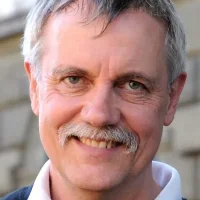
Prof. Dr. Ruedi Aebersold
ETH Zurich
About:
Born 1954 in Oberdiessbach
BE, SwitzerlandDissertation in cell biology
at the Biocenter, University of
BaselPostdoctoral fellow at Caltech, California
Assistant professor at the
University of British Columbia in VancouverProfessor at the University of Washington in Seattle
Professor at the Institute of System Biology in Seattle
- Professor at ETH Zurich and
the University of Zurich